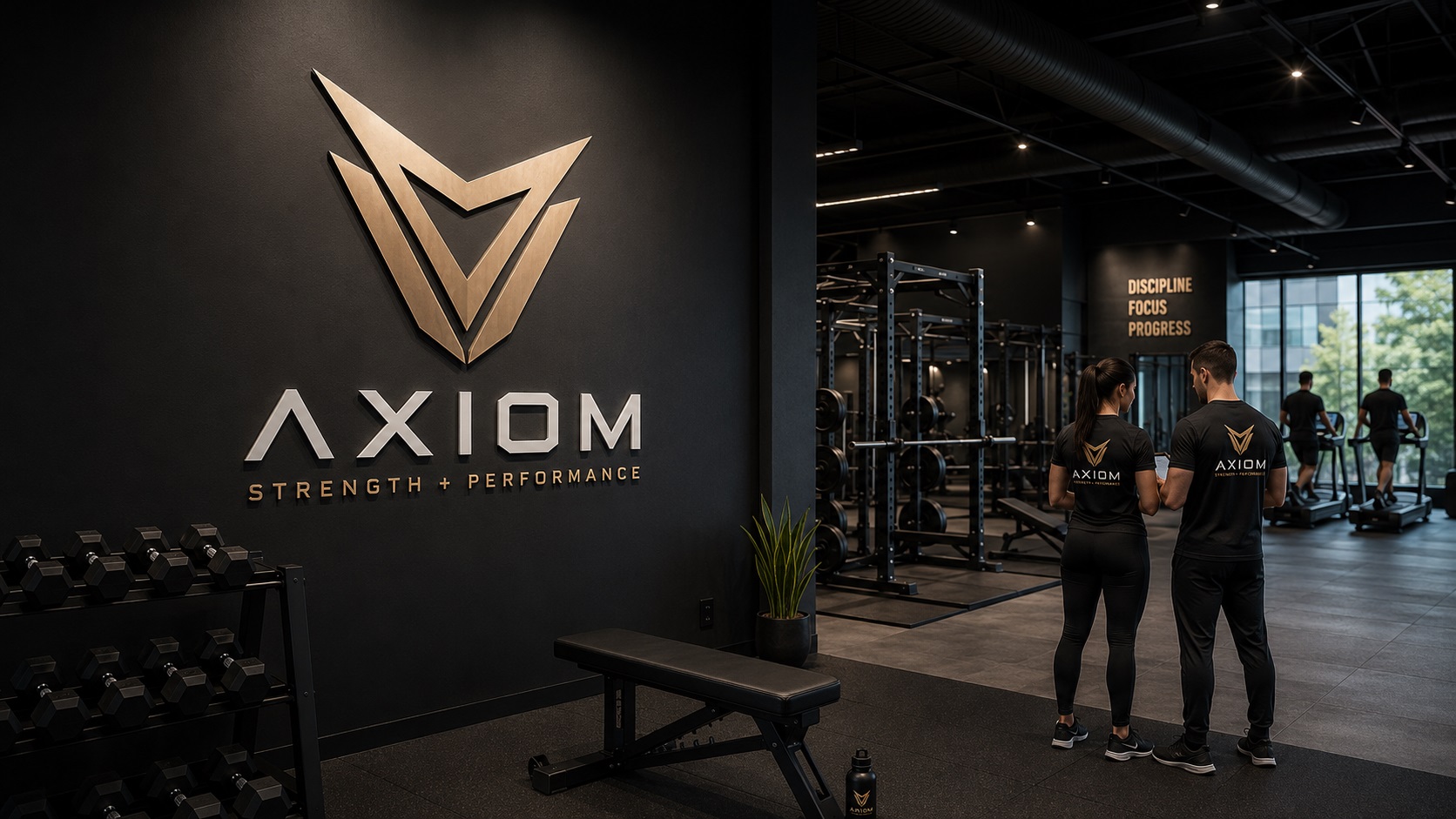
Fitness businesses put their brand through some of the toughest conditions of any industry. Logos end up on gym walls, equipment, membership cards, workout gear, team uniforms, outdoor signage, vehicle wraps, and across every social platform imaginable. That is a lot of surfaces, a lot of sizes, and a lot of different vendors all asking for the same thing: a file that actually works.
If your gym, personal training business, fitness studio, or sports brand only has a PNG logo, here is where that becomes a problem and what to do about it.
Gym Walls and Interior Signage
Large wall graphics are one of the most visible branding elements inside a fitness facility. A logo or motivational graphic printed or applied directly to a wall at several feet wide is something clients see every single session. At that scale, a raster file will not produce the sharp, professional result the space deserves.
Sign companies and vinyl installers who produce wall graphics need vector files. Whether the graphic is printed on vinyl and applied, painted using a stencil, or fabricated as dimensional letters, the artwork going in needs to be vector.
Apparel and Branded Gear
Branded apparel is central to fitness business identity. Gym t-shirts, hoodies, caps, training shorts, and staff uniforms are all common. Screen printing and embroidery are the two most used production methods, and both require vector source files.
For screen printing, the file needs to be a clean vector with flat, separated colors. For embroidery on caps, polo shirts, and staff uniforms, the digitizer needs a clear vector source to work from accurately.
Equipment Branding and Stickers
Custom stickers and equipment decals are another common fitness branding application. Branded vinyl stickers on equipment, water bottles, gym bags, and lockers all require clean vector artwork for the cutting and printing process.
Die-cut stickers, where the sticker is cut to the exact shape of the logo, specifically require vector cut paths. Without a proper vector file, custom die-cut sticker orders either get rejected or require the supplier to convert the file at extra cost.
Outdoor and Vehicle Signage
Gyms with outdoor signage, window graphics, roadside banners, or branded vehicles all need vector files. These are exactly the situations where a PNG logo, however well it looks on screen, will not produce professional results at the sizes involved.
What a Complete Vector File Set Looks Like for a Fitness Brand
- AI and EPS for screen printers, sign shops, and embroidery
- SVG for website and digital use
- PDF for sharing with designers and event organisers
- PNG with transparent background for social media and digital marketing
- Full color, white, and single-color black versions
- Brand color values in CMYK and Pantone
Frequently Asked Questions
My gym logo was designed in Canva. Can it be vectorized?
Yes. A vectorization service can redraw your Canva logo as a proper vector file that works for all print and production applications.
We want to sell branded gym merchandise. What files do we need?
For print-on-demand, a high-resolution transparent PNG is the minimum. For screen printing or embroidery on larger orders, you need an EPS or AI file.
Do we need a different version for embroidery versus screen printing?
The same vector source works for both. If your logo has very fine detail, a simplified embroidery-friendly version may also be worth having.
We have multiple gym locations. How do we manage logo files?
A shared cloud folder with the complete file set, accessible to all location managers and their vendors, prevents inconsistencies across locations.
Need artwork converted?
VectorFixer can redraw logos, convert PNG files to SVG, and prepare clean production-ready vector files.
Contact Us