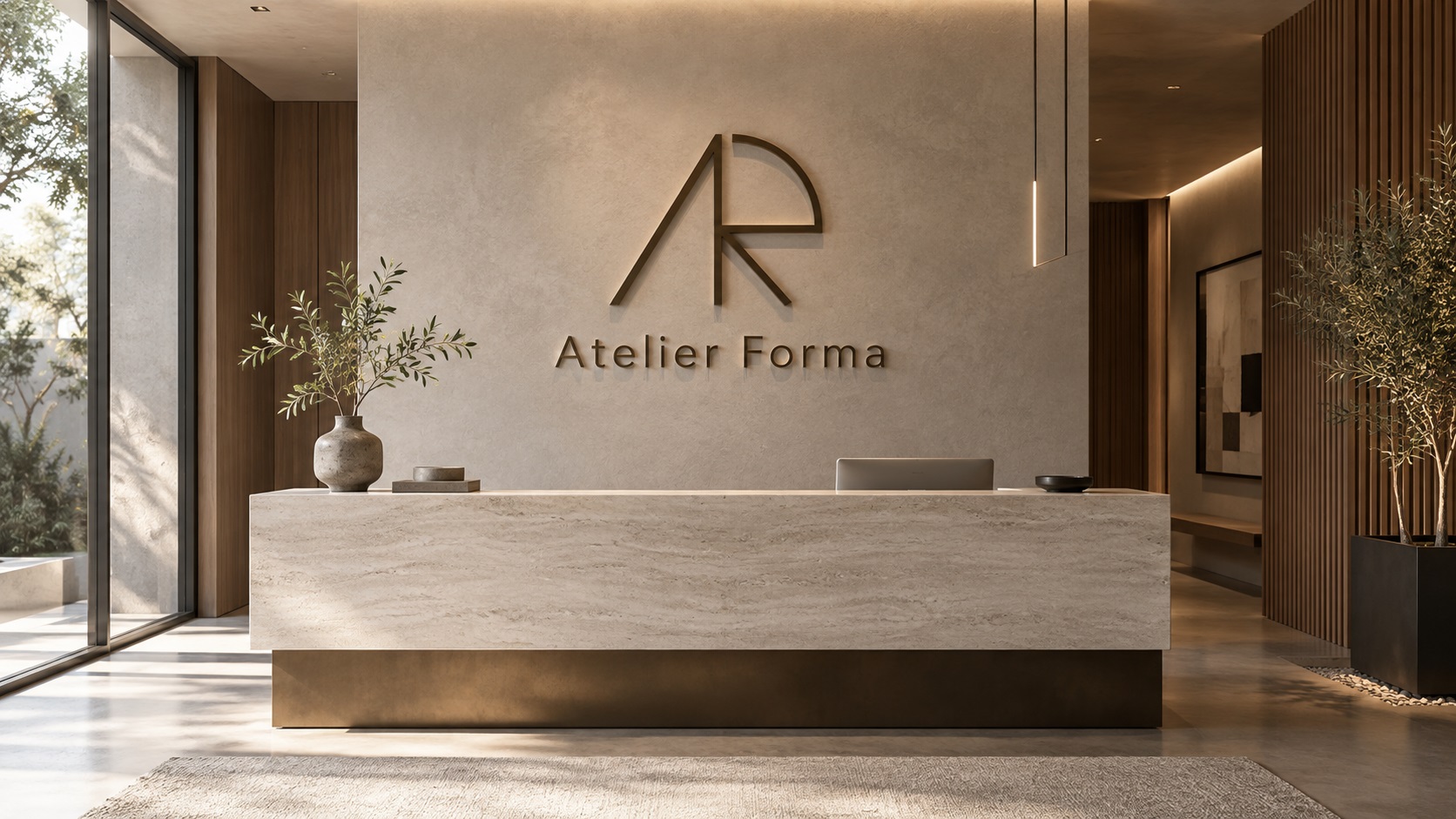
Architects, interior designers, and design studios have some of the most visually demanding branding environments of any profession. A studio that creates beautiful spaces for clients needs its own brand to reflect the same level of quality and intention. And the surfaces where that brand appears, from laser-cut office signage to printed portfolios and exhibition displays, are among the most scrutinised in any professional context.
Here is how vector files apply to architectural and interior design branding, and why getting the files right matters particularly in this industry.
The Surfaces Where Design Studio Logos Appear
An architecture or interior design practice puts its logo in contexts that demand precision.
Office and Studio Signage
The reception area and entrance of a design studio is itself a design statement. Dimensional letters, laser-cut metal or acrylic signage, etched glass panels, and printed vinyl graphics are all common in studio environments. Every one of these requires a clean vector file, and in the case of fabricated signage, the quality of the vector directly determines how accurately the sign maker can produce the design.
For laser-cut dimensional letters and precision-cut acrylic, the vector paths need to be exceptionally clean. Any irregularity in the path translates directly into a visible imperfection in the fabricated piece.
Printed Portfolios and Project Books
Architectural practices produce printed portfolios, project brochures, and case study documents that are handed to clients, submitted with tenders, and displayed at professional events. These are high-quality print productions where every element of the design needs to be at its best.
A vector logo placed in a portfolio layout is sharp regardless of the page size or print quality. A raster PNG placed in the same layout may show quality limitations that are particularly visible on the premium paper stocks and high-resolution printing processes typically used for architectural printed material.
Exhibition and Awards Submissions
Architecture and interior design awards are significant marketing opportunities. Awards submissions, exhibition displays, and professional directories all include the studio logo. The range of output sizes is wide, from a small logo in a printed programme to a large sign at an awards ceremony. A vector file handles all of these without any quality compromise.
Wayfinding and Environmental Graphics
Many design practices also handle wayfinding and environmental graphic design projects for clients. The tools and file standards used in this work, including clean vector files, established color systems, and well-structured artwork packages, are the same standards that should apply to the practice's own brand.
Branded Materials and Client Gifts
High-end stationery, engraved business card holders, branded notebooks, and quality client gifts are common in design practices that serve premium markets. Engraving, embossing, foil stamping, and pad printing on these items all require clean vector files and often single-color versions of the logo.
Digital Presence and Project Photography
Architecture and interior design practices invest heavily in project photography and digital portfolios. The logo appears as a watermark on images, in website headers, and in social media graphics. An SVG logo displays sharply on every screen at every resolution, which matters for a studio whose work is judged on visual quality.
Why Design Practices Particularly Cannot Afford Poor File Quality
In most industries, a slightly blurry logo on a promotional item is an embarrassment that gets noticed by few people. In architecture and interior design, clients and peers are trained visual observers. They notice when a studio's own branding does not reflect the same quality standards it applies to client work.
A practice that produces meticulously detailed drawings and precise material specifications for client projects, but submits a PNG logo for its own signage, creates an incongruity that clients and collaborators notice.
This is not hypothetical. Signage fabricators who work with architectural practices regularly see logo files that would not be accepted in any design studio context if they appeared in client artwork. The irony is that design professionals are among the most likely people to understand why the file format matters, and yet among the most likely to have neglected it for their own practice branding.
File Standards for Design Practice Branding
For an architecture or interior design practice, the minimum file set should include:
- AI source file with all elements on clearly named layers, fonts outlined, and colors defined
- EPS for fabricators, sign makers, and external print vendors
- SVG for website, social media, and digital use
- PDF for documents, tenders, and correspondence
- PNG with transparent background in multiple sizes for digital everyday use
- Single-color versions in black and white for engraving, embossing, and single-color print applications
- Brand color values in CMYK and Pantone
For practices that produce wayfinding or environmental graphic design for clients, the same level of documentation applied to client brand assets should apply to the practice's own brand. A practice brand guide that specifies file formats, color values, and usage rules is a useful document for any studio that involves multiple designers in producing branded materials.
Adapting the Logo for Fabricated Signage
For laser-cut, CNC-routed, or fabricated signage, the vector file needs to meet stricter path quality standards than for standard print use.
Paths need to be closed, with no open ends that would cause a cutting machine to leave an unfinished cut. The minimum feature size needs to be checked against the capabilities of the fabrication method. For laser cutting in acrylic or metal, very fine elements may not be achievable at certain thicknesses and need to be adjusted or removed.
A vectorization service that delivers clean paths with verified path closure and minimal anchor point counts gives fabricators exactly what they need. Messy auto-traced paths or paths with thousands of unnecessary anchor points cause problems in CNC and laser cutting workflows.
Frequently Asked Questions
Our studio logo was designed by a previous partner who has left. We cannot find the original files. What are our options?
This is a common situation in design practices where file management was informal. A vectorization service can recreate the logo from any existing printed or digital source material. If the logo appears on old letterheads, business cards, signage, or a website, those provide enough reference for an accurate recreation.
We are rebranding and want to update our logo. Do we need to go back to our original designer?
Not necessarily. If you have a clear idea of what needs to change, a designer or vectorization service can update an existing logo file rather than rebuilding from scratch. For significant rebrands, engaging a designer for the creative work and ensuring proper file delivery at the end is the cleaner approach.
We produce wayfinding graphics for clients. Should our own logo files meet the same standards as the files we produce for client projects?
Absolutely. The file quality and documentation standards that you would apply to a client brand asset package should apply to your own brand. Anything less is an inconsistency that is noticeable in a professional context.
Our logo includes bespoke lettering that was hand-drawn. Can that be converted to a clean vector without losing the bespoke character?
Yes. Manual vectorization by an experienced designer preserves the hand-drawn character of custom lettering while producing clean, scalable paths. The goal is accuracy, not sanitisation.
What color format should we use for a logo that appears on both printed materials and digital screens?
Define your brand color in hex and RGB for digital use, and in CMYK and Pantone for print. A complete color specification across all four systems means every vendor and every context is covered.
Get Your Practice Logo Production Ready
If your architecture or interior design studio logo needs to be in proper vector format for fabricated signage, printed portfolios, or any other professional production context, VectorFix can deliver a clean, correctly structured file set ready for any supplier.
Order your vector file at VectorFixer and give your practice brand the same standard you apply to your client work.
Need artwork converted?
VectorFixer can redraw logos, convert PNG files to SVG, and prepare clean production-ready vector files.
Contact Us