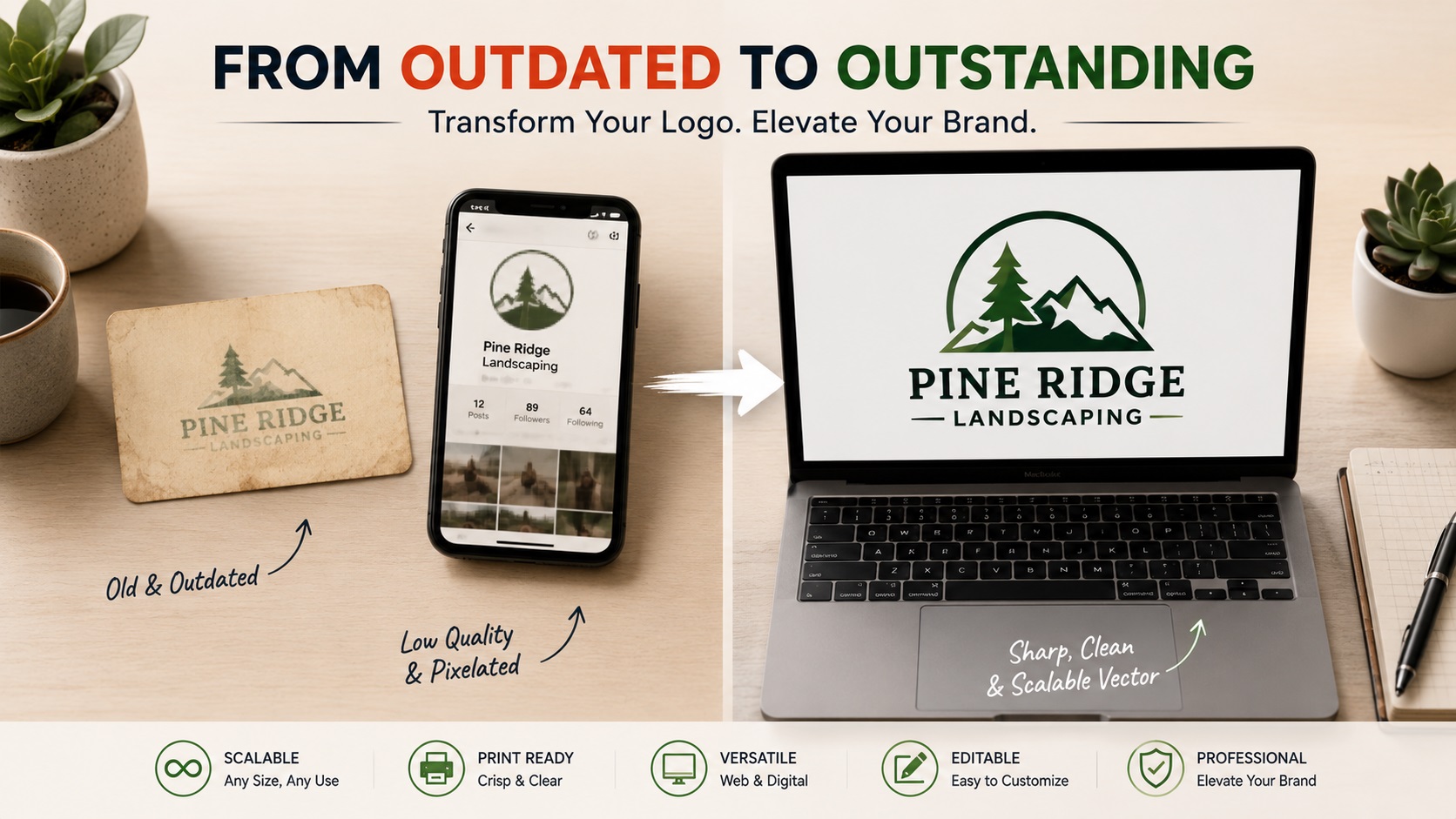
It happens more than you would think. A business has been running for years with the same logo, but at some point the original files got lost. Maybe the designer who created it is long gone and never handed over the source files. Maybe a hard drive died. Maybe the logo was made by a family member in a program that no longer exists. Whatever the reason, all that is left is a low-quality image on the website, an old business card, or a faded letterhead scan.
This does not mean you are stuck. Here is how logo recreation actually works and what you can expect from the process.
Why You Might Need a Logo Recreation
People come to logo recreation services for a few different reasons.
Sometimes the original design files simply never existed in a proper format. A lot of small business logos were originally made in Word, Paint, Canva, or even PowerPoint. These programs do not produce professional vector files, so there was never a clean source file to begin with.
Other times the files did exist but were lost. A designer moved on without handing them over. A computer crashed without a backup. Files got deleted during a website migration.
Occasionally a business finds a really old logo they want to bring back, one that predates digital design entirely. All that exists is a scan of printed material or a physical sign.
In all of these cases, the goal is the same: end up with a clean, professional vector version of the logo that works for printing, signage, embroidery, and digital use.
What a Logo Recreation Actually Involves
Logo recreation is not the same as logo design. You are not creating something new. The goal is to reproduce the existing logo as accurately as possible in a format that actually works.
A designer takes whatever source material you have and redraws the logo from scratch using vector software. Every shape, line, curve, and letter is rebuilt by hand. The original image serves as a reference, not as the actual file being used.
This is different from vector tracing in that recreation sometimes requires more interpretation. If the source image is very small, faded, or damaged, some details may not be perfectly clear. A good designer will get as close as possible and flag anything that requires a judgment call.
What Source Material Can Be Used
Most professional logo recreation services can work from almost anything you have available. Some common starting points:
- A small JPG or PNG pulled from your website
- A photo of a business card, letterhead, or printed invoice
- A scan of old printed materials
- A photo taken of a sign, vehicle, or storefront
- A screenshot of your logo from social media
- A low-quality email attachment
The cleaner and larger the source, the more accurate the recreation will be. But experienced designers can work from quite limited material. If you have multiple sources, such as a business card and a website image, providing all of them gives the designer more detail to work from.
What About the Font?
One of the trickier parts of logo recreation is text. If your logo includes a business name or tagline, the designer needs to either identify the original font or find one that matches as closely as possible.
For many logos, especially ones built from common fonts, this is straightforward. Tools exist to help identify fonts from images, and experienced designers have a good eye for common typefaces.
For custom lettering or heavily modified text, the designer may need to hand-draw the letterforms rather than use a font. This takes more time but can get very close to the original.
If the original font cannot be identified precisely, the designer will typically choose the closest available match. This is worth knowing upfront if exact font matching is important to you.
What Colors Will You Get Back?
Colors in a recreation are matched as closely as possible to the source material. If your source is a digital image, the designer can sample the color values directly. If the source is a printed piece, there may be some variation since print colors are not always a perfect digital match.
If you know your original brand color values, whether as hex codes, RGB values, CMYK breakdowns, or Pantone references, share them with the designer. This guarantees the most accurate color match regardless of how the source material looks.
Can You Make Small Changes During Recreation?
This is worth asking your service provider about upfront. Many logo recreation services will stick strictly to reproducing what exists in the source material. Others are open to small adjustments, such as updating a color, modernizing a font slightly, or cleaning up an element that was never quite right in the original.
If you want changes beyond a straight recreation, be clear about that from the start. Some services handle basic adjustments as part of the same job. Larger changes start moving into logo redesign territory, which is a different service with different pricing.
What You Will Receive
A good logo recreation should deliver:
- The logo redrawn as a clean vector file
- Multiple formats: AI or EPS for print, SVG for digital use, PDF for easy sharing
- Colors matched to the original or specified brand values
- All elements as separate, editable paths
Once you have the vector file, keep it somewhere safe and backed up. This is now your master logo file. Share copies with any printer, designer, or vendor who needs it, but always keep the original.
Frequently Asked Questions
Can any logo be recreated no matter how old or damaged the source is?
Almost always yes, though the level of accuracy depends on how much detail is visible in the source. Very small or heavily damaged sources may require some interpretation, and the designer should communicate clearly about any areas where they had to make judgment calls.
How is logo recreation different from logo redesign?
Recreation aims to reproduce the existing logo as accurately as possible. Redesign means creating something new or substantially changed. If you just want your existing logo in a usable format, recreation is what you need.
How long does it take?
For most logos, a professional can complete a recreation within one to two business days. More complex logos with lots of detail, custom lettering, or unclear source material may take a little longer.
What if the designer cannot identify my original font?
They will use the closest available match or hand-draw the letterforms. If exact font matching matters to you, mention it when placing your order and ask how they handle this situation.
Will I be able to edit the file myself after?
Yes. The vector files you receive are fully editable in Adobe Illustrator and similar software. Colors, shapes, and text can all be adjusted.
Need artwork converted?
VectorFixer can redraw logos, convert PNG files to SVG, and prepare clean production-ready vector files.
Contact Us