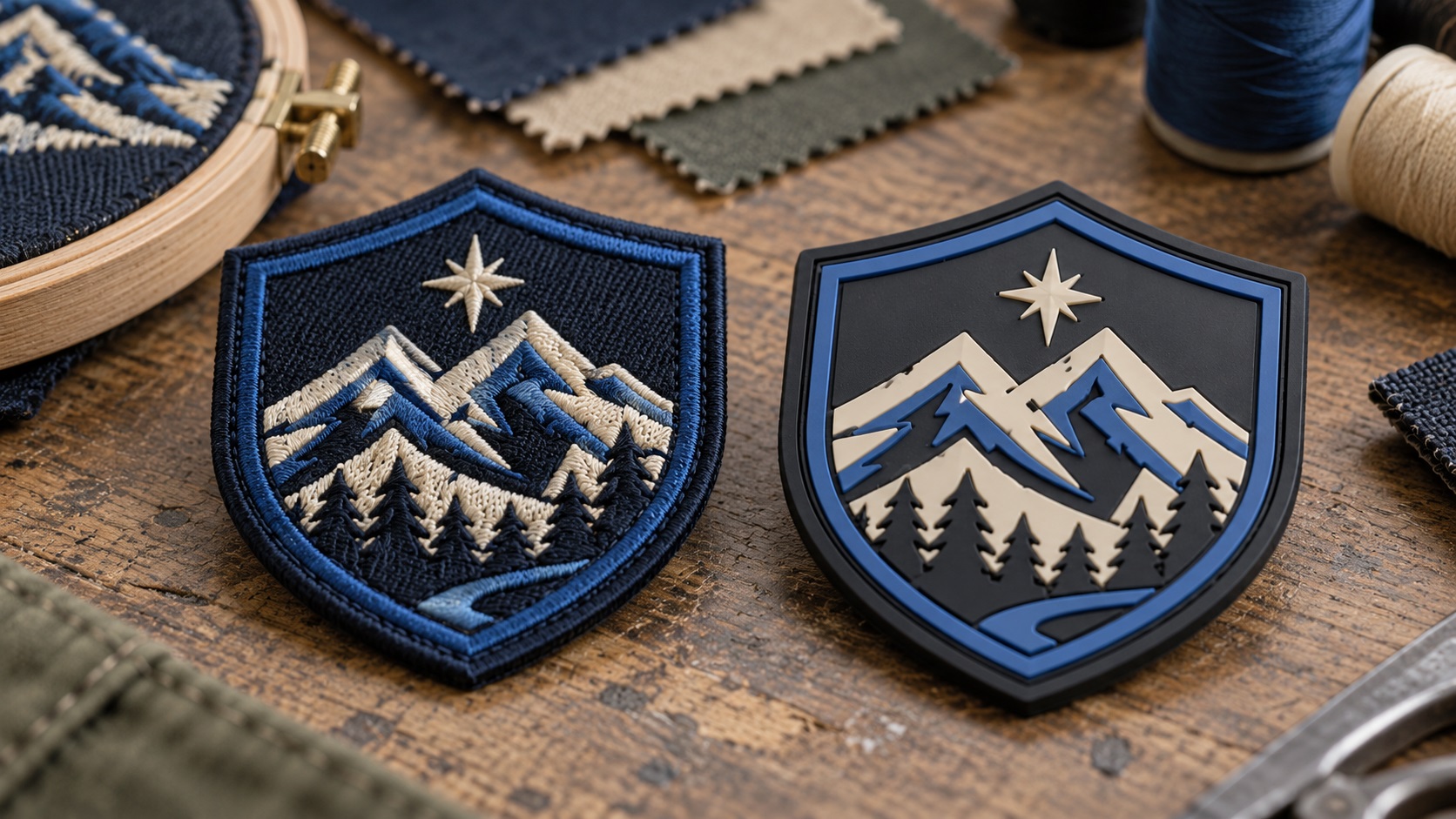
Custom patches are a popular way to put a business logo on uniforms, jackets, bags, hats, and branded merchandise. But a logo that looks great as an embroidered patch may not work the same way as a molded PVC patch.
The difference is not simply the surface finish.
Embroidered patches are built from thread. PVC patches are formed from flexible molded material. That changes which details survive, how small text looks, and how the artwork should be prepared.
If your logo has fine lettering, a detailed icon, or several colors, choosing the right patch method before ordering can save revisions and setup costs.
What is the difference between embroidered and PVC patches?
An embroidered patch uses colored thread stitched into a fabric backing. The result has a traditional textured surface, often with a stitched border.
A PVC patch is made from flexible, molded material with separate color areas. A manufacturer can create raised and recessed sections that give the design depth.
Both can carry business branding, but they interpret artwork differently.
The best choice depends on your logo, the finished dimensions, where the patch will be used, and the style you want.
When embroidered patches are a good fit
Embroidery works especially well for logos with:
- Bold lettering.
- Simple badges or crests.
- Large recognizable symbols.
- Limited color areas.
- A traditional uniform or club appearance.
Thread has a distinct visual character. A simple round logo stitched on twill can look familiar and professional on work jackets, caps, and uniforms.
Some designs look better with the slight texture of thread than they would with a perfectly flat graphic.
But embroidery has physical limits. Thin strokes, small gaps, and closely spaced letters can become difficult to read when stitched at a small size.
When PVC patches are a good fit
PVC patches are often chosen for bags, outdoor gear, caps, workwear, and promotional products where a molded, rubber-like surface fits the design.
They are particularly useful for logos with:
- Bold color sections.
- Clearly defined outlines.
- A strong icon.
- Raised or recessed details.
- A modern molded appearance.
PVC patches can be easier to wipe clean and are often selected for wet or dirty environments. However, overall durability depends on the material formulation, backing, attachment, and how the patch is used.
Do not assume every PVC patch is equally flexible, weather-resistant, or suitable for washing. Ask the supplier for the specific care and attachment requirements.
Can PVC patches reproduce smaller details than embroidery?
Sometimes, but not automatically.
Molded PVC can create crisp boundaries between solid color areas, which may help certain logos with small lettering and line details.
However, a mold still needs sufficient width, spacing, and depth for each physical part to form correctly.
Very small letters can close up. Narrow gaps can disappear. Thin raised elements may be fragile.
An SVG with 1,000 tiny details will not necessarily become a good PVC patch just because it is vector.
The supplier should confirm its own minimum feature sizes at the planned finished dimensions.
Why small text is a problem for both patch types
Imagine a two-inch business patch carrying a company name, slogan, founding date, location, and phone number.
That is a lot of information for a small physical object.
In embroidery, stitches can merge inside short letters.
In PVC, tiny raised letters and narrow gaps can be difficult to mold and read.
For both methods, consider the most important information.
A practical patch might keep:
- The business initials.
- A recognizable icon.
- The main brand name.
- One short phrase, only if it remains readable.
Move long website addresses and detailed slogans to packaging, printed labels, or larger branding surfaces instead.
What if your logo contains gradients?
This is one of the most common file-preparation problems.
A digital gradient transitions smoothly from one color to another. Standard embroidery uses individual thread colors, while ordinary molded PVC uses discrete material color sections.
Neither produces an unrestricted photographic gradient in the same way as a screen.
If your logo fades from blue to purple, you might need an approved patch version using solid blue, solid purple, or two clearly separated shapes.
For a gradient-heavy design, a printed patch may be a better option than either ordinary embroidery or molded PVC.
The right answer depends on the visual effect you need, not on the file extension.
What if your logo contains fine outlines?
Fine outlines can be important to brand recognition, especially around custom lettering or an icon.
But an outline that is only a fraction of a millimeter wide on the finished patch may not reproduce properly.
For embroidered patches, a narrow thread line can look uneven or disappear against a textured background.
For PVC patches, the raised or recessed line still needs enough material thickness to form.
Ask the manufacturer for its recommended minimum stroke width for your selected material and patch size.
If necessary, a production copy can thicken lines slightly while keeping the overall design recognizable.
Embroidered versus PVC patches for multi-color logos
Both methods can use multiple colors, but suppliers may limit how colors are handled and priced.
In embroidery, thread colors are chosen from available thread ranges. A subtle screen color may be matched to the closest suitable thread.
In PVC, separate molded color areas need to be specified for manufacturing.
The manufacturer may charge differently for additional colors or complex molds, especially for smaller orders.
Before placing the order, confirm:
- The number of colors included in the quote.
- Whether the background counts as a color.
- The closest available material or thread matches.
- Whether special finishes cost more.
- Whether an additional mold or setup charge applies.
A physical color sample is more useful than assuming the online mockup is exact.
Do both patch types use the same artwork file?
The same clean vector master can be a starting point for either process.
Common source formats include AI, EPS, SVG, and vector PDF. Different suppliers may also accept high-resolution PNG or JPG artwork for reference.
But the final production files will not necessarily be identical.
For embroidered patches
The digitizer needs to translate the artwork into stitch instructions. It decides stitch paths, underlay, density, thread changes, and other machine-specific settings.
A vector file is source artwork, not a finished embroidery stitch file.
For PVC patches
The manufacturer needs clearly separated molded color areas and an understandable design for raised, recessed, and flat details.
A layered vector file can make it easier to review individual shapes and colors before tooling.
A detailed illustration built from hundreds of overlapping paths may need cleanup even if it looks perfect on screen.
VectorFixer's vector cleanup service can help simplify problematic paths and remove stray shapes before a supplier reviews the design.
Why the final size matters more than your screen preview
A patch design on a computer screen might fill the width of your monitor. The actual manufactured patch may be only two inches across.
At that size, every thin line becomes smaller. Letter spacing tightens. Details that were obvious at 200% zoom may almost disappear.
When comparing materials, ask for proofs shown at actual physical size.
A useful test is to print a basic full-size paper reference at 100% scale. It will not reproduce the final texture, but it helps reveal whether the logo contains too much information.
For an expensive order, request a real sample if the supplier offers one.
Which edge style works best?
Patch shape and border construction also influence the artwork.
Embroidered patches
A traditional merrowed border creates a raised stitched edge. It works well on many straightforward shapes, including circles, squares, ovals, and shields.
More unusual outlines may use a different border or cutting method.
PVC patches
The molded outline can follow many custom shapes, but thin projections and tiny notches can still be difficult to manufacture.
An aggressive zigzag edge may need simplification if it leaves narrow pieces that could tear or catch.
Ask for the supplier's shape and safe-area requirements before drawing an elaborate custom outline.
Keep critical text and symbols comfortably away from the border.
How will the patch attach to the product?
Attachment is often treated as an afterthought, but it affects the job.
Common options may include:
- Sew-on backing.
- Hook-and-loop attachment.
- Adhesive backing.
- Heat-applied options, where the material and supplier support them.
Not every backing is available or suitable for every PVC or embroidered patch.
For uniforms that will be washed repeatedly, ask the manufacturer which backing and attachment method it recommends.
For removable bag or jacket patches, hook-and-loop may be more useful.
The patch itself and how it is attached should be considered as one product.
What about logos on uniforms versus outdoor bags?
An embroidered badge can be a natural fit for a polo, blazer, school uniform, or club jacket.
PVC can be attractive on backpacks, equipment bags, outerwear, and products where a molded look fits the brand.
These are tendencies, not rules. Some uniform buyers prefer PVC, while many outdoor brands use embroidered patches successfully.
Think about whether the finished product should feel traditional, rugged, playful, or technical.
Then evaluate the actual design and material requirements.
Will a clean vector file prevent patch problems?
It helps, but it is not the whole solution.
A strong vector master should have:
- Smooth, intentional paths.
- No unnecessary hidden objects.
- Clean letter shapes.
- Clearly defined color sections.
- Correct proportions.
- No accidental gaps or overlaps.
- A separate editable master and production copy.
Even with that file, the artwork may need method-specific changes.
For example, a fine script wordmark may need thicker strokes for embroidery, while a PVC patch may need adjusted spacing and depth between color regions.
If the only available artwork is a small screenshot or old JPG, manual logo vectorization can recreate the main brand shapes before a manufacturer adapts them for patches.
How to compare quotes fairly
Do not compare only the price per patch.
One supplier may include setup, proofing, and backing. Another may quote those separately.
Request comparable specifications for both patch types:
- Finished patch width and height.
- Quantity.
- Number of colors.
- Border and shape.
- Backing or attachment method.
- Material and thickness.
- Mold or digitizing charges.
- Proof and sample policy.
- Delivery and shipping.
- Reorder terms.
For PVC, ask whether a mold charge applies and what happens if you reorder the same design.
For embroidery, ask whether digitizing is included and whether the stitch file can be reused for similar orders.
A practical decision example
Suppose your brand logo is a bold mountain icon with a short company name underneath.
For staff jackets, an embroidered patch may produce the traditional textured appearance you want.
For equipment bags frequently exposed to rain and dirt, a PVC version might better match the desired finish and cleaning needs.
Now imagine the same logo contains a tiny map, an elaborate gradient sky, and a long slogan.
Both patch methods may require simplification, or you may want to consider a printed patch instead.
The design is the starting point. The material follows the desired result.
What to send your patch supplier
A useful handoff package includes:
- A clean vector logo if available.
- A PNG reference showing approved colors.
- The exact finished patch dimensions.
- Intended garment or product.
- Preferred patch method.
- Required text that cannot be removed.
- The approved number of colors.
- Border and backing preferences.
- Any desired raised or recessed areas.
- A note stating which details may be simplified.
If you need both embroidered and PVC versions, tell the supplier. The same brand master may be adapted into two distinct production layouts.
Frequently asked questions
Are PVC patches better for small text than embroidered patches?
They can be clearer for some small solid-color details, but very tiny text can fail in either process. Use your manufacturer's actual-size proof.
Are PVC patches waterproof?
Many PVC patches resist water well, but the overall product and attachment performance depend on materials and construction. Check the supplier's specifications.
Can embroidered patches reproduce gradients?
Standard embroidery cannot reproduce continuous digital gradients exactly. Gradients may be simplified into separate thread colors or approximated using stitch techniques.
Can I send a PNG instead of a vector file?
Some patch makers accept PNGs as references. A clean vector master gives them more control when separating colors, simplifying details, or preparing molds.
Is a PVC patch always more expensive?
Not necessarily. Quantity, mold fees, color count, complexity, size, and backing all affect price. Compare complete quotes rather than assumptions.
Choose the patch material after checking the artwork
An embroidered patch and a PVC patch can communicate the same logo while looking and behaving differently.
Choose the effect you want, view your design at the real finished size, and ask the supplier to confirm minimum details before paying for production.
If the only logo you have is blurry, flattened, or built with messy traced paths, send it to VectorFix with your patch dimensions and supplier requirements. A clean vector master can then be adapted for embroidery, PVC, or another product without losing the core brand design.
Need artwork converted?
VectorFixer can redraw logos, convert PNG files to SVG, and prepare clean production-ready vector files.
Contact Us