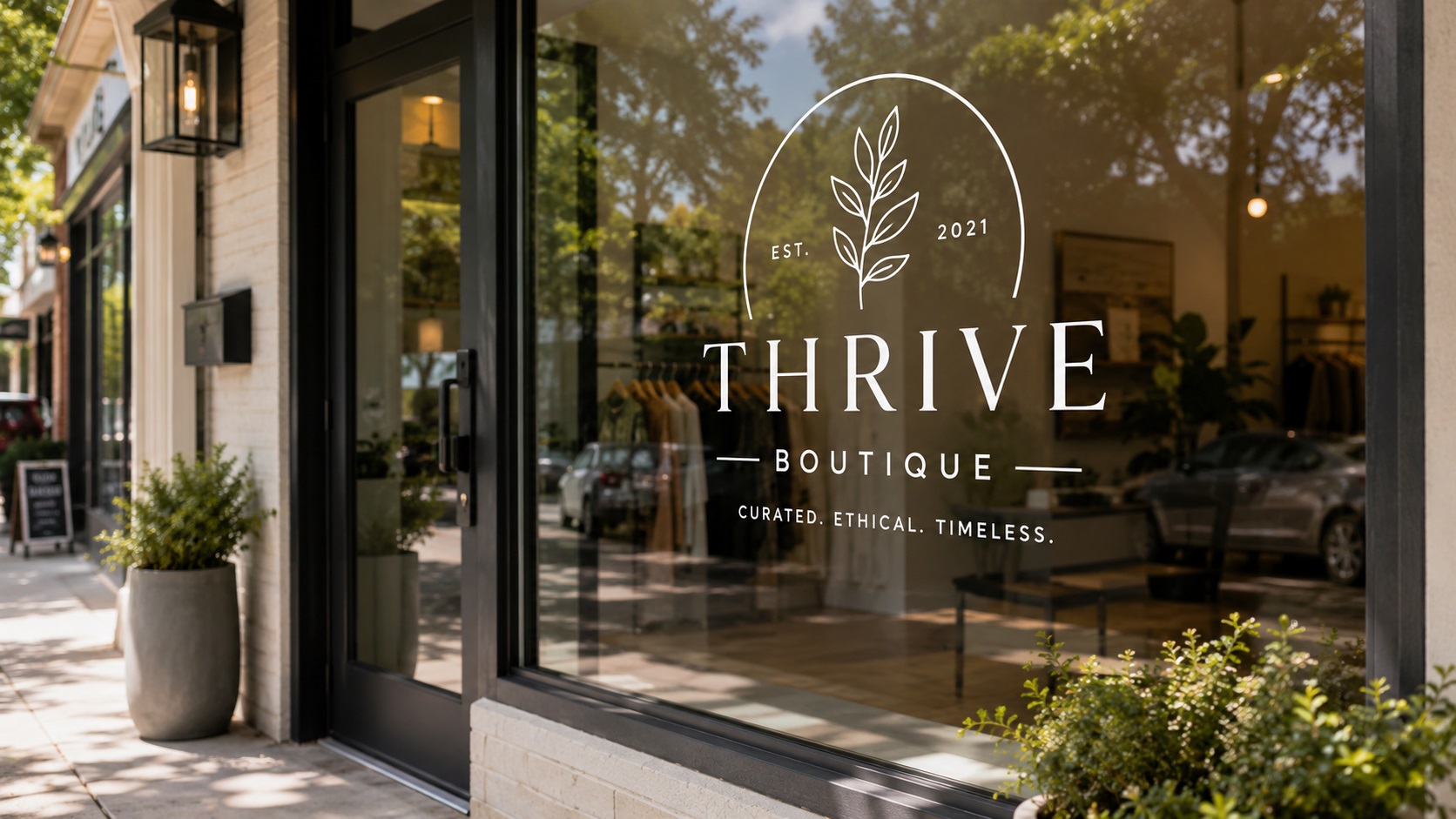
A storefront window is prime real estate. It is the first thing people see whether they are walking by, driving past, or peering in before deciding to come inside. Window decals and storefront graphics are one of the most cost-effective ways to make a strong first impression, but they have their own specific file requirements that catch a lot of business owners off guard.
Here is what you need to know before ordering window graphics for your storefront.
Types of Window Graphics
There are a few common formats for storefront window decoration, and each has slightly different design and file considerations.
Cut vinyl lettering and logos: Individual letters or shapes cut from solid color vinyl and applied directly to the glass. No background, just the shape itself.
Printed and cut decals: Full-color graphics printed on vinyl or clear film, then cut to the shape of the design. This allows for photos, gradients, and complex multi-color artwork that cut vinyl cannot achieve.
Perforated window film: A specialty material with tiny holes that allows people inside to see out while the design is visible from outside. Common for storefront branding combined with privacy.
Frosted or etched vinyl: Creates a frosted glass appearance for the design areas, often used for a more upscale, subtle look.
Each of these processes treats your artwork slightly differently, so it helps to know which one you are ordering before preparing your files.
File Requirements for Cut Vinyl Window Graphics
If you are getting your logo or text cut from solid vinyl, the file needs to be a clean vector with closed paths, similar to what is needed for vehicle wraps or vinyl cutting projects.
A few specific considerations for window application:
Mirrored text for interior application: If a decal will be applied to the inside of the glass so it reads correctly from outside, the design needs to be mirrored (flipped horizontally) before cutting. This is a common point of confusion, and getting it wrong means ordering the decal again.
Connected letterforms: Cut vinyl letters need enough connection points to hold together during application. Letters like A, O, and B have natural enclosed areas that need small bridges (called weld points) to keep the center pieces attached during installation. A designer experienced in vinyl cutting will know how to handle this properly.
Color limitations: Cut vinyl is limited to solid colors, one layer per color. If your logo has many colors or gradients, this format will require simplification or a switch to printed decals instead.
File Requirements for Printed and Cut Decals
Full-color printed decals have more flexibility since they are printed rather than cut from solid color material. They can include photos, gradients, and complex multi-color designs.
For these, you will need:
- High-resolution artwork for the printed portion (photos and complex graphics)
- A vector cut path defining the outer shape the decal should be cut to
- Correct color values in CMYK, since these are printed using the same color process as other large format printing
The vector cut path is important even for printed decals. The printer needs a precise shape to follow when cutting the finished decal out of the printed sheet. This is usually a separate vector layer or file alongside your main printed artwork.
Sizing Considerations
Window graphics are viewed from two very different distances depending on context. A passerby on the sidewalk might be a few feet away. Someone driving past might be viewing your storefront from across the street or further. Think about your primary audience and design accordingly.
Text that needs to be readable from a moving vehicle needs to be significantly larger and bolder than text meant to be read by someone standing at your door. If your storefront window graphics serve double duty for both audiences, consider a layout with a larger, simpler primary element (like your logo or business name) and smaller supporting details for those who get closer.
Working Around Window Obstacles
Real storefront windows are not blank canvases. Window frames, mullions (the dividing bars between glass panes), door handles, and existing signage all affect where your design can go and how it will look once installed.
Before finalizing your design, measure your actual window space and account for any obstacles. Many sign shops will ask for photos and measurements of your storefront to help plan the layout properly. Providing this information upfront avoids surprises when the decal arrives and does not fit the space as expected.
Color and Contrast Against Glass
Glass is reflective and often shows whatever is happening on the other side, whether that is interior lighting, a dark store interior, or the reflection of the street outside. This can affect how your design colors actually appear once installed.
Light colors and white tend to show up clearly against most backgrounds. Dark colors can sometimes blend into a dark store interior when viewed from outside during the day. If high visibility matters, consider how your colors will read against both the interior of your space and varying outdoor lighting conditions throughout the day.
Getting Your Logo Ready for Window Graphics
If your logo only exists as a raster file like a PNG or JPG, it needs to be converted to a vector before it can be used for cut vinyl window graphics. For printed decals, a vector version is still recommended even though the file technically could be raster, because vector files scale cleanly to whatever size your window decal ends up being and avoid any pixelation in the logo portion of the design.
If your logo includes fine detail, very thin lines, or small text, some simplification may be needed for cut vinyl applications specifically, since cutting machines have practical limits on how fine a detail can be cut and weeded successfully.
Frequently Asked Questions
Do I need to mirror my logo for window decals?
Only if the decal will be applied to the inside surface of the glass. Exterior-applied decals do not need mirroring. Always confirm with your sign shop which application method they are using.
Can perforated window film use any logo design?
Most designs work, but very fine detail can be harder to make out due to the perforated texture of the material. Bold, simple designs tend to translate best to perforated film.
How long do window decals typically last?
This depends on the material quality and environmental exposure, but most professional-grade vinyl decals last several years when properly installed, with outdoor-facing decals typically having a shorter lifespan than interior-applied ones due to UV and weather exposure.
Can I apply window decals myself?
Small, simple decals can often be self-applied with careful technique. Larger or more complex installations, especially anything involving precise alignment across multiple panels, are usually better handled by a professional installer to avoid air bubbles, misalignment, or wasted material.
What if my storefront has multiple window panes with mullions in between?
Your sign shop can design around this, either by sizing the graphic to fit within a single pane or by planning a layout that intentionally spans across multiple panes in a way that still looks intentional. Provide accurate measurements and photos so this can be planned properly.
Need artwork converted?
VectorFixer can redraw logos, convert PNG files to SVG, and prepare clean production-ready vector files.
Contact Us